
Classic Story Structure Explained

Updated: Dec 23, 2025
We’re heading back to school with this one. I’m sure we all remember the graphic of a roller coaster with the words inciting incident, rising and falling action, climax, etc, but do you remember what it actually all means? Ready for a refresher before we dive into some more detailed story structures? Good!

Introduction to the Classic “Roller Coaster” Structure
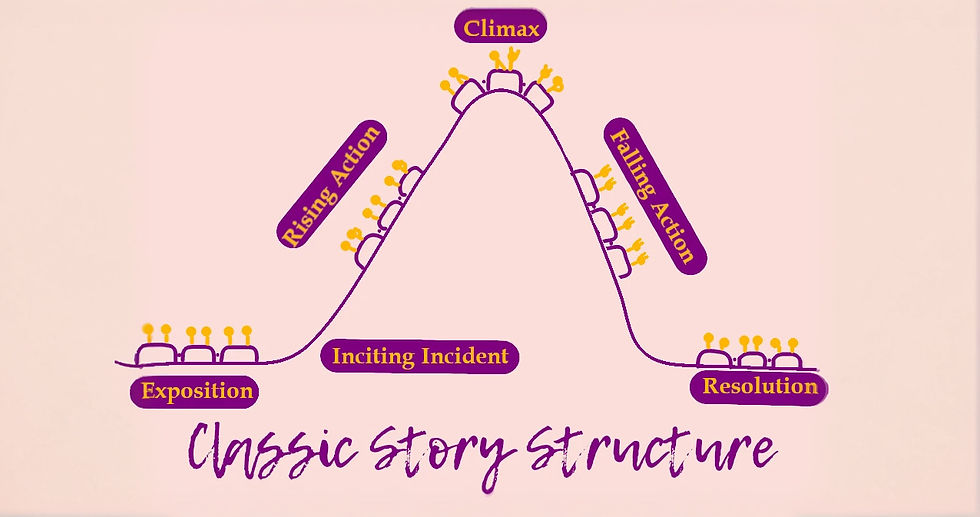
This is usually referred to as the classic structure, but I always think of that handout we got over and over again in school of the roller coaster, so that is always how I remember it. The graphic is a line which starts out flat, slowly curves up to a point, dashes back down and flattens out again. It is a good visual depiction of what a story does; you can’t argue that. Now, sometimes there might be a bit more up and down, some sharp turns, maybe a loop but the start, up, down, end is pretty heckin’ standard.
We’ll dive into each section of track deeper below, but let’s understand the roller coaster as a whole. Here's the classic story structure explained!

We start with exposition, that first bit of the coaster where we’re just getting some speed. In a story this is establishing the norm. Its length depends heavily on pacing.

Next we hit the spot in the coaster where we begin our ascent. This is the inciting action or the point in the story where something throws the norm off balance.
The part of the coaster where we are climbing to the peak is the rising action. This is where our main character chooses to try something different to get what they want and is hit with obstacles along the way.

After the tension of the climb, we hit the peak of our ascent: the story’s climax. After all the tension of failures, successes, and waiting for the other shoe to drop, our main character reaches their goal.
But that success changes the status quo and what goes up, must come down.
Our cart now plummets back down to earth; after the climax comes the falling action. This is when our main character begins to realize that there are consequences to everything, good and bad. Just as there were obstacles on the way to the win, there will be obstacles in returning to a new normal.

The ride flattens out, we roll back into the station, and a story resolution unfolds where our main character assumes a new normal. It’s back to the grind of life but our character, and likely their environment, has changed.
Let’s Design Our Own Coaster
Let’s set-up an example to pull through these sections! I’m thinking Hallmark romance kinda thing to show that it’s not just dangerous mysteries and horrors that follow this structure but simple happily ever after romances too.
Exposition: Establishing the Norm
The exposition section of story structure works as the set-up for the rest of the story. This is where readers get their bearings, learn about and become invested in the characters, and get a feel for the tone and atmosphere of the setting and narrative.
This is also where the hook comes in. In the introduction of the story you need to promise the reader something, set up the stakes and expectations, and grab their attention by creating curiosity.
In our exposition we will introduce a main character who works an entry level job with aspirations for moving up in the company and has had a string of bad dates. Maybe we open with her telling her best friend and coworker about her weekend around the water cooler on a Monday morning.
Immediately we create curiosity and conflict between these two aspirations, introduce a relatable character and start somewhere interesting that shows, not tells, of these desires and frustrations.
Inciting Incident - A Change
The inciting incident is where the story actually becomes a story if that makes sense. Catalyst is a good word to describe it. This is the moment where everything changes: a call to action, a new opportunity, a tragedy, hitting rock bottom… It upsets the normal flow of our characters' lives.
This event provides the opportunity for our character to alter their life course and pursue their dreams, save their family or business, fix a wrong they committed, prove they’re a different person than everyone thinks they are… A necessary element of a good story is that the main character is changed by the end; the inciting incident is what begins that transformation.
In our inciting incident, at some point during the day or week it is made known to our main character that a position just opened in the level above her. They plan on hiring internally and applications are due on Monday. To add to the drama of it all, she finds out through a so-called rival coworker. They've been there for around the same amount of time and have similar skills.
The incident itself is the opening of this position. With this scene, we provide internal and external conflict and introduce an antagonist.
Rising action - The Obstacles
The rising action is a series of events which challenge our main character on their way to the climax and the achievement of their goals. This is where all the juicy action and building tension happens. It’s the will-they-wont-theys of romance, the nagging injuries of action, and the dead ends of mystery.
Ideally, each new obstacle is more painstaking than the last. As the story proceeds the stakes are higher and our characters have more to lose because they’ve slowly gained with their previous wins. Of course, not every obstacle or conflict will be won. Slide backs are part of the game and help to build tension and evoke emotion.
The first obstacle created was in the previous scene, by introducing our antagonist but additionally, our main character has another date lined up this weekend. She’s forced to make a decision between going on this date or having less time to work on her application. Later on she needs to perform well in an interview. In between these obvious obstacles she is faced with workplace drama, a date she actually enjoyed and therefore a budding new relationship and the choice between career and love.
Obviously, we won’t look into all the obstacles, but this gives you an idea of the action rising toward our climax.
Climax - The Release
The climax is the moment where everything seems to fall together. A great weight is lifted as our characters reach their goals. This is the final standoff, it’s the saying yes, it’s the murderer being discovered.
While the goal may have been reached, we still need to create tension because the change that happens after the climax is going to upset the status quo forever. The climax requires one “final” decision or obstacle for our protagonist. It’s an “all or nothing” moment.
Our climax will be the ultimate decision between career and love. Does our main character choose overtime to look good for the position and skip out on the romantic weekend their partner has planned? Since we’re going for a classic Hallmark romance… She goes with her partner. (But consider the story that might occur if they chose the overtime… also interesting!)
But, clearly, the story isn’t over yet. There’s still too many pages left in the book. This is not the happily ever after… yet.
Falling Action - The Consequences
The falling action is everything that happens because of the climax’s outcome. Every action has consequences, but consequences aren’t necessarily bad! The fallout is simply the changes our characters have to face. Think of the falling action as the reflection on the journey. If your character has travelled across the land to free a captive princess… What did they learn along the way and who did they meet? How will this affect their return home and following, more mundane, life? If your character completed a rehabilitation program… What supports do they return to? Will they stay clean?
This is where the character and the reader come to terms with the themes of the story and where your promise to the reader is fulfilled. This is the mirror to the rising action, we build and build and build the tension and now, post climax we slowly release it as we bring the story home.
Our falling action will have our main character come to terms with the fact that she may not get the job, but also how she has chosen her relationship. Scenes of the romantic weekend will reveal how supportive their partner is of their ambitions, when they return to work there will be a scene of confrontation with the antagonist who is confident they will be getting the job and our character will have to come to terms with their jealousy and failure.
The falling action will be a series of finding the silver linings and weighing the good against the bad.
Resolution - The New Norm
The resolution is where things get tied up in a pretty bow (sometimes.) There's always the opportunity for an open ending, but be sure to provide enough closure that your reader doesn’t feel betrayed. This is where character arcs end, the story is tied up and the themes come to a head. If a lesson is to be learned by the reader, this is the time to really nail it home (like, don’t be too heavy handed, cover it in some nice prose, but… you get it.)
If your story is to continue, now's the time to drop some hints for the next story. If it’s over, you have the option to tie it up nicely or also go the hint route and allow the reader some room for interpretation.
Our resolution will be clear and I’ve decided we’re going all out on the happily-ever-after. Not only does our main character choose love over career and have a loving supportive relationship, it turns out, during that overtime weekend, the rival made a huge mistake and our main character gets offered the promotion. I think we’ll leave it open as to whether they take it or not to allow the reader to decide what lessons were learned and what risks the character is willing to take with this new relationship and the career's time commitment.
And that’s the end folks. The roller coaster is over and it’s time to find a new one to ride.
Is this the right structure for you?
Yes! Because these beats exist in all the other story structures (with nuance!) which is why we started here. While there may be a more specific structure that would work for you, this is a catch-all option.
We’ll be taking a look at some more structures over the following months like Freytag's Pyramid, the Hero’s Journey, Dan Harmon’s Story Circle, the Fichtean Curve, the Three Act Structure and the Seven Point Structure. Is there one that you’d like to see done next? Let me know, because I haven’t actually decided yet!
Watch the video!

Jerrica is a writer and editor who inspires up-and-coming writers to create compelling fiction and creative nonfiction works while providing them with the confidence to do it themselves or ask for a helping hand when they need it. She enjoys speculative fiction, horror and gut-wrenching emotion with a side of food & drink and the cozier things in life.


Comments